Billing and invoice control
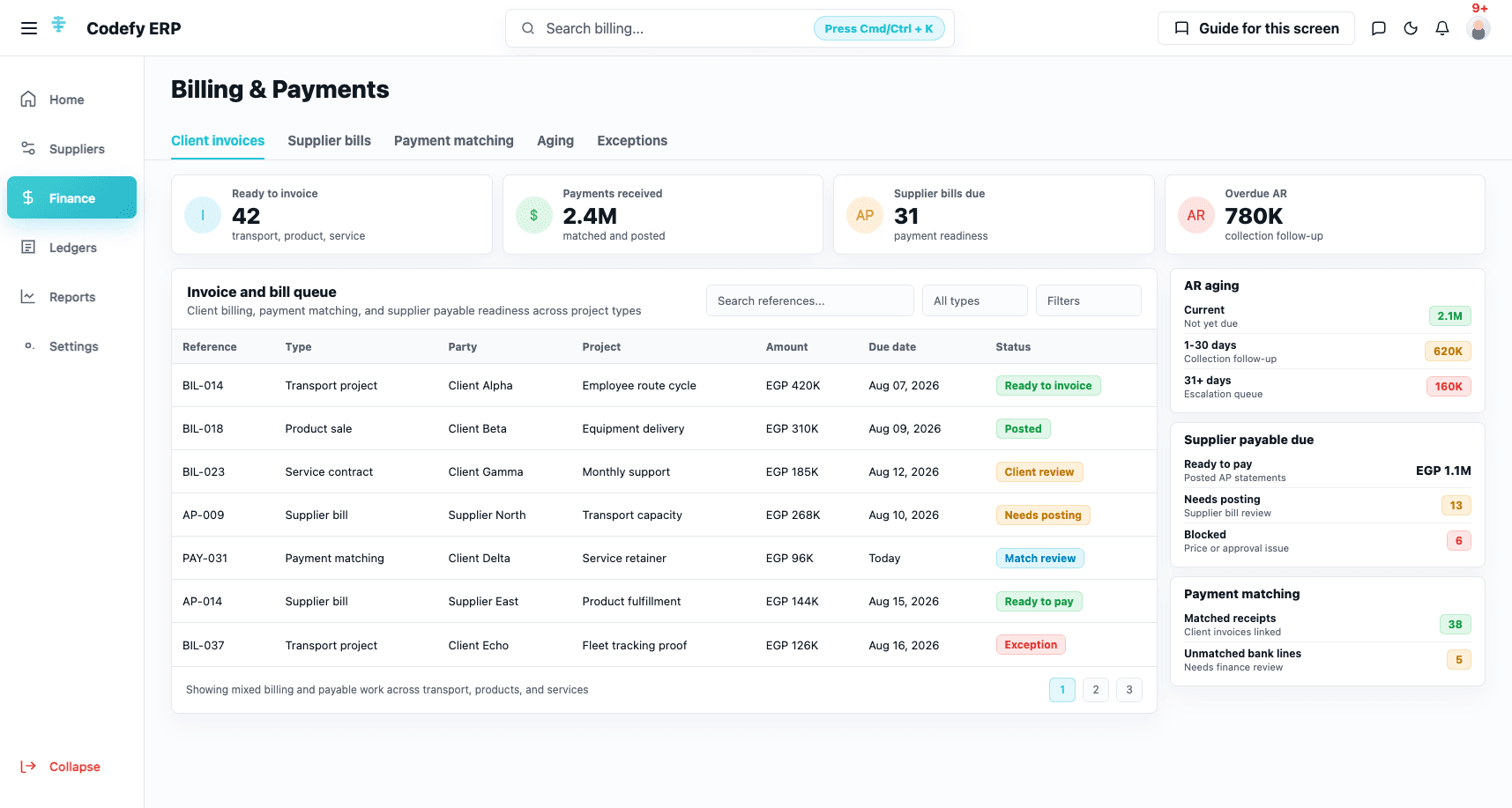
Generate, review, send, approve, print, void, and collect receivable invoices while keeping client, project, line-item, payment, balance, and approval context connected.



Codefy ERP Module
Turn operational activity into controlled financial records, from invoices, payments, expenses, payroll liabilities, and supplier/client balances to journals, ledgers, reconciliation, statements, and close.
Operating Chain
Finance work fails when invoices, payments, expenses, payroll liabilities, supplier settlement, journals, ledgers, and statements are handled as disconnected tasks. Codefy ERP keeps the operational source and accounting result traceable.
Step 1
Configure accounts
Step 2
Generate invoices
Step 3
Record payments
Step 4
Post journals
Step 5
Review ledgers
Step 6
Reconcile balances
Step 7
Close period
Finance Controls
The module connects daily money movement with accounting control. Operations create invoices, payments, expenses, and obligations; finance controls posting rules, ledgers, reconciliation, statements, period locks, and audit review.
Generate, review, send, approve, print, void, and collect receivable invoices while keeping client, project, line-item, payment, balance, and approval context connected.
Manage pay-in and pay-out records, cash and bank accounts, payment methods, corrections, reversals, payment history, and cash movement visibility.
Control chart of accounts, posting rules, balanced journal entries, manual journals, opening balances, general ledger, AR ledger, AP ledger, and source-linked posting events.
Review reconciliation health, payment sync, cash flow, forecasts, trial balance, P&L, balance sheet, period locks, close guidance, and finance audit signals.
Smart Logic
Codefy ERP validates finance posting before it reaches the ledger: source identity, tenant account ownership, active accounts, debit and credit balance, period locks, reversal-only corrections, and reconciliation health all protect the accounting layer.
Create and manage receivable invoices from client and project work, with line items, due dates, client approval, payment history, balance due, print output, and period-lock awareness.
Track incoming and outgoing payments with account selection, payment methods, correction flows, reversal state, source document links, and cash/bank account visibility.
Connect expense payments, recurring expenses, liabilities, staff payroll, driver payroll, employee loans, supplier advances, and payroll payable context to finance control.
Define the accounting structure that every financial workflow posts into, including account types, categories, hierarchy, system roles, posting guides, templates, and rule resolution.
Support controlled manual entries and source-linked automatic posting while enforcing balanced debit and credit lines, account validity, source identity, and period controls.
Give finance teams ledger-level visibility across journal entry lines, running balances, client receivables, supplier payables, supplier receivables, adjustments, payments, and source references.
Screens
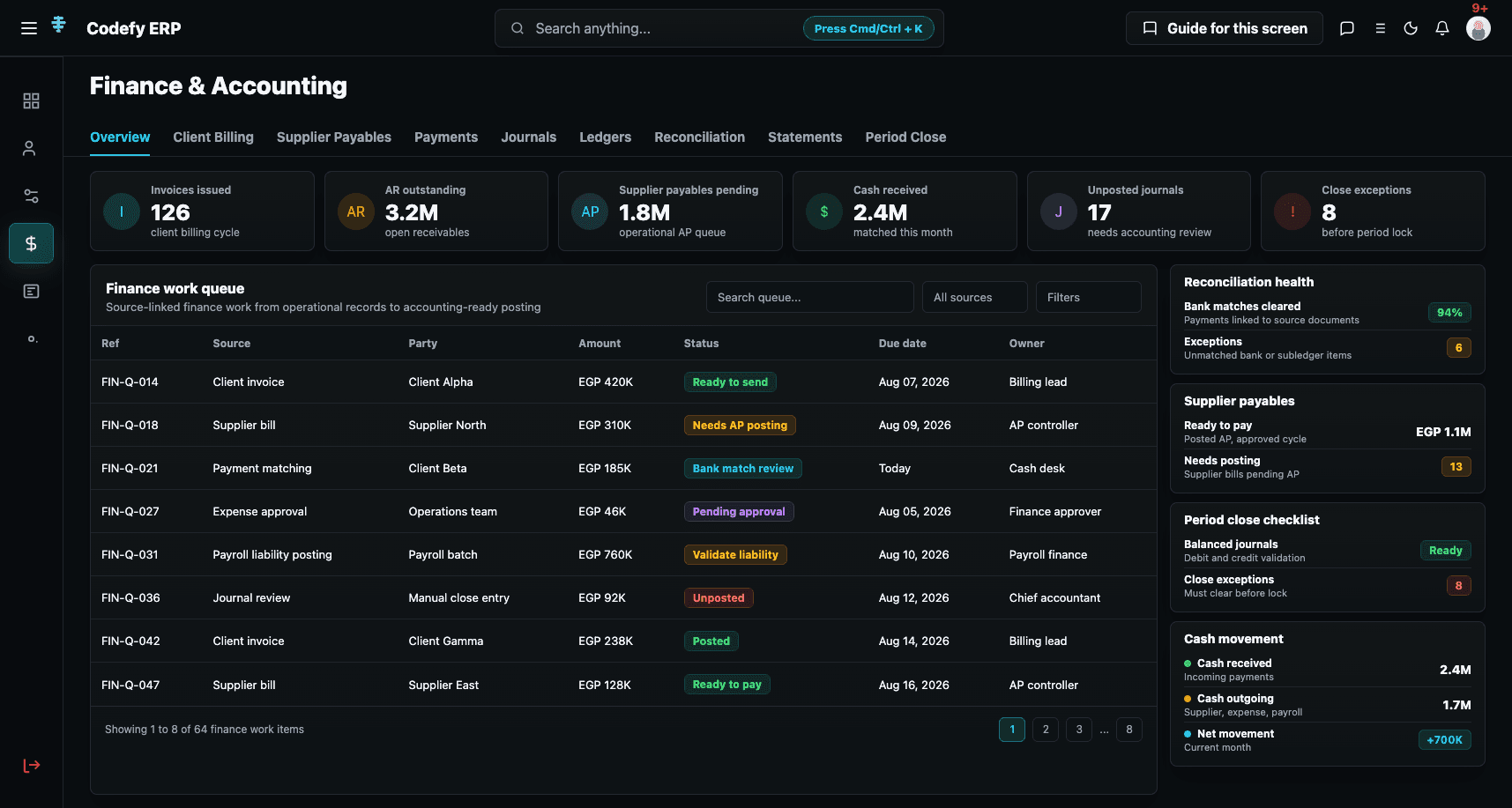
The module needs one finance command center for daily money movement and one accounting control surface for ledgers, journals, reconciliation, statements, and period close.
Finance command center
A finance workspace for receivables, payables, cash, invoices, payments, expenses, payroll liabilities, profitability, cash flow, reconciliation, and period status.
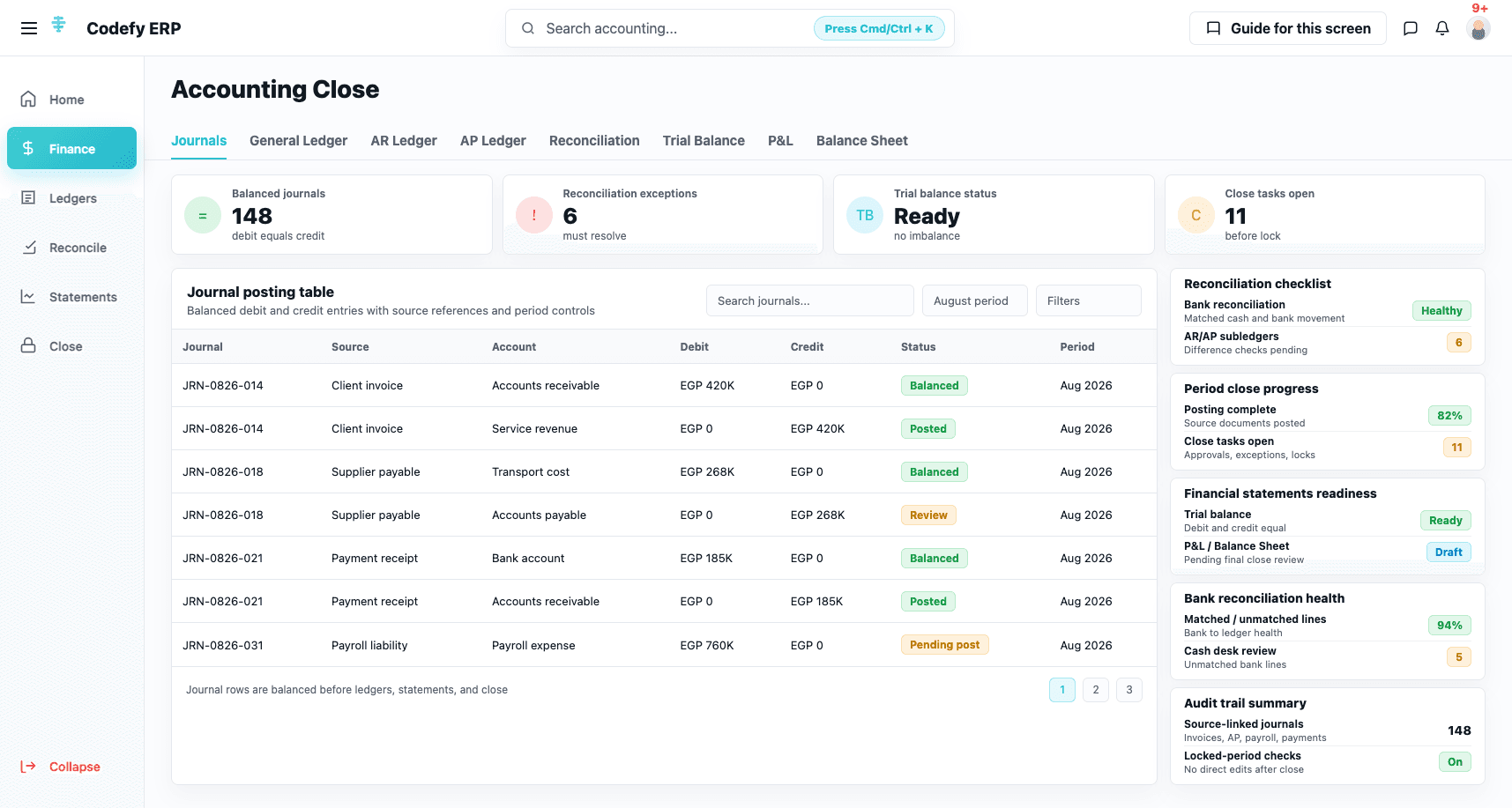
Accounting control
Finance teams can review chart of accounts, posting rules, manual journals, general ledger, AR/AP ledgers, reconciliation health, trial balance, P&L, balance sheet, and period locks.
Commercial Value
The same finance layer supports invoices, payments, expenses, payroll liabilities, cash accounts, journals, ledgers, reconciliation, financial statements, and period close.
Operations and finance teams can connect invoices, payments, expenses, payroll liabilities, and cash movement to the accounting records they create.
Supplier payables stay operationally visible in Supplier Management while Finance owns the accounting truth through AP ledger, journals, reconciliation, and close.
Management can review receivables, payables, cash, profitability, statements, reconciliation issues, and locked periods without separating operations from accounting.
Finance teams protect the books with balanced posting, active account validation, period locks, reversal controls, source references, and reconciliation health checks.
We can review your billing, invoices, payments, expenses, payroll liabilities, chart of accounts, posting rules, ledgers, reconciliation, statements, and period-close needs, then map the right Codefy ERP starting point.