Agent management
Create, configure, test, and manage assistants with model selection, agent settings, widget state, usage visibility, and active tenant governance.



Codefy ERP Module
Use agents for knowledge-grounded help, bulk import validation, reporting, guided work, widgets, and permission-aware actions.
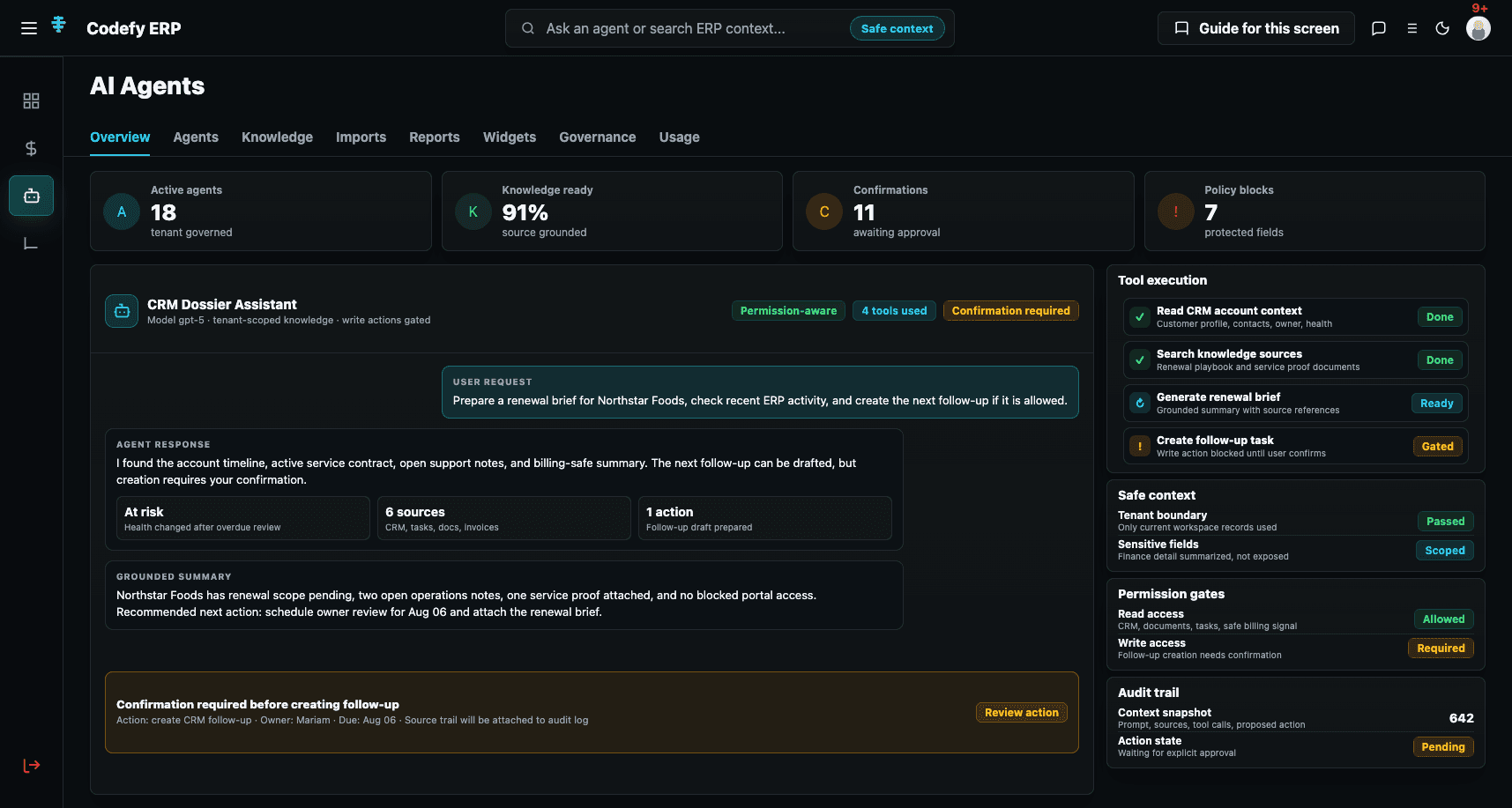
Agent Runtime
Codefy ERP agents are positioned as governed assistants, not disconnected chatbots. They work with approved data context, knowledge sources, capability boundaries, and confirmation gates.
Step 1
Select agent
Step 2
Load safe context
Step 3
Ground in knowledge
Step 4
Validate request
Step 5
Draft response
Step 6
Confirm action
Step 7
Audit outcome
Agent Modes
Create, configure, test, and manage assistants with model selection, agent settings, widget state, usage visibility, and active tenant governance.
Connect agents to tenant-scoped knowledge sources, operating documents, approved context, source retrieval, and knowledge readiness checks.
Use AI to validate messy uploads, detect missing fields, transform project data, prepare assignments, and explain validation issues before records are created.
Support operations, finance, CRM, support, and reporting workflows with permission-aware answers, safe read context, and confirmation before controlled writes.
Governance Logic
The runtime separates understanding from authority: agents can reason, summarize, validate, draft, and guide, while permissions, tenant scope, safe catalogs, write confirmations, billing, and audit remain enforced.
Manage AI assistants with agent records, model selection, prompt setup, test surfaces, status, widget readiness, and tenant-aware configuration.
Ground responses in approved knowledge sources, operating documents, safe business context, and source-aware retrieval instead of generic chatbot memory.
Help users transform operational spreadsheets into structured ERP records while surfacing missing fields, entity matches, assignment readiness, and review steps.
Use system agents for operational overviews, client dossiers, support navigation, finance-safe reporting, project health, assignment coverage, and follow-up guidance.
Let users ask for reports and operational intelligence through approved data context, safe query tools, capped outputs, inline expansion patterns, and source-aware summaries.
Publish selected assistants as widgets with active state, allowed domains, structured lead capture, authentication options, and safe public boundaries.
Screens
The module should show one command center for agent management and one runtime control surface for knowledge, imports, reports, confirmations, and governance.
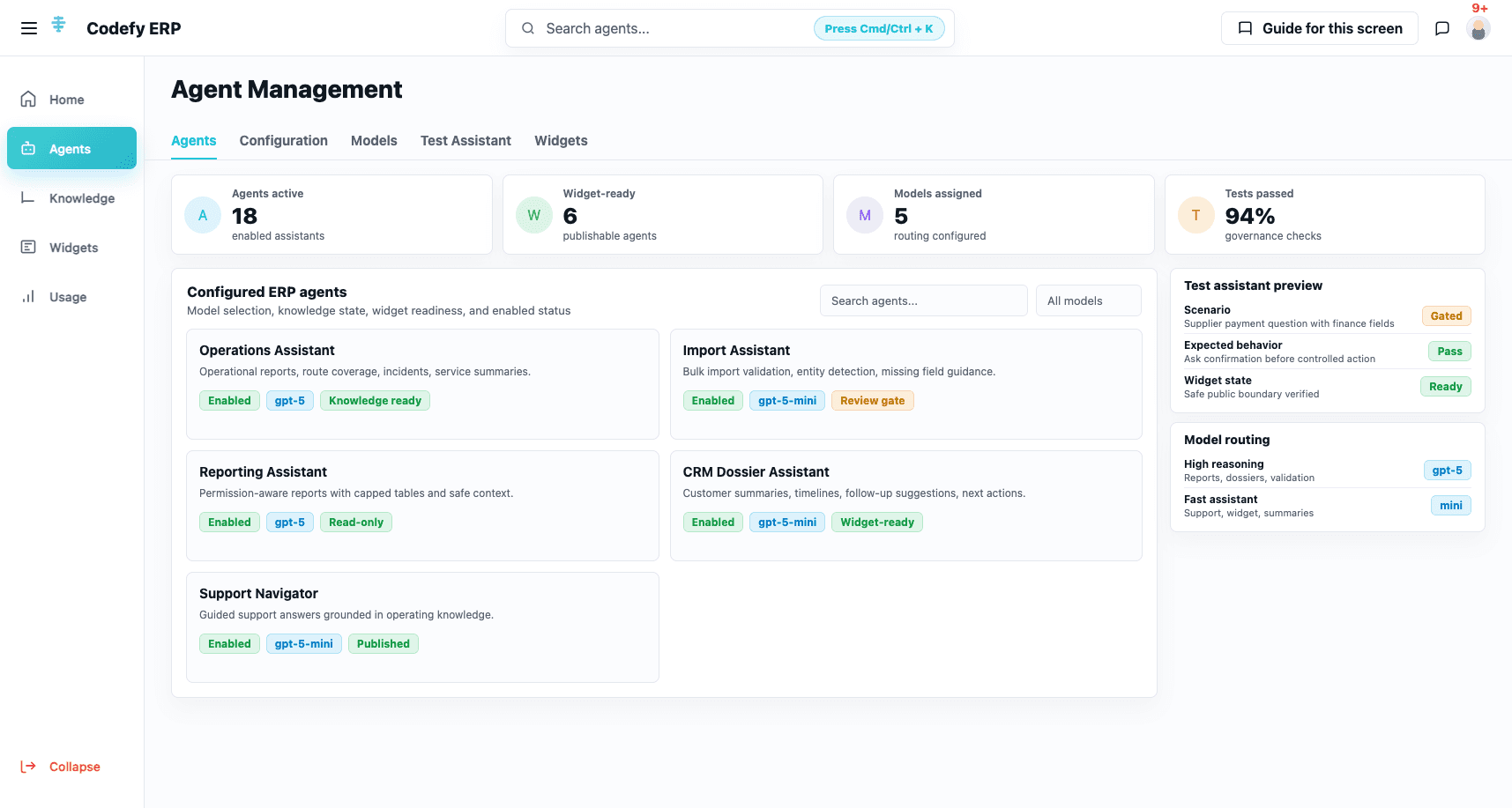
AI agent command center
A governed agent workspace for active assistants, model state, knowledge readiness, widget publishing, import validation, reporting, usage, and setup health.
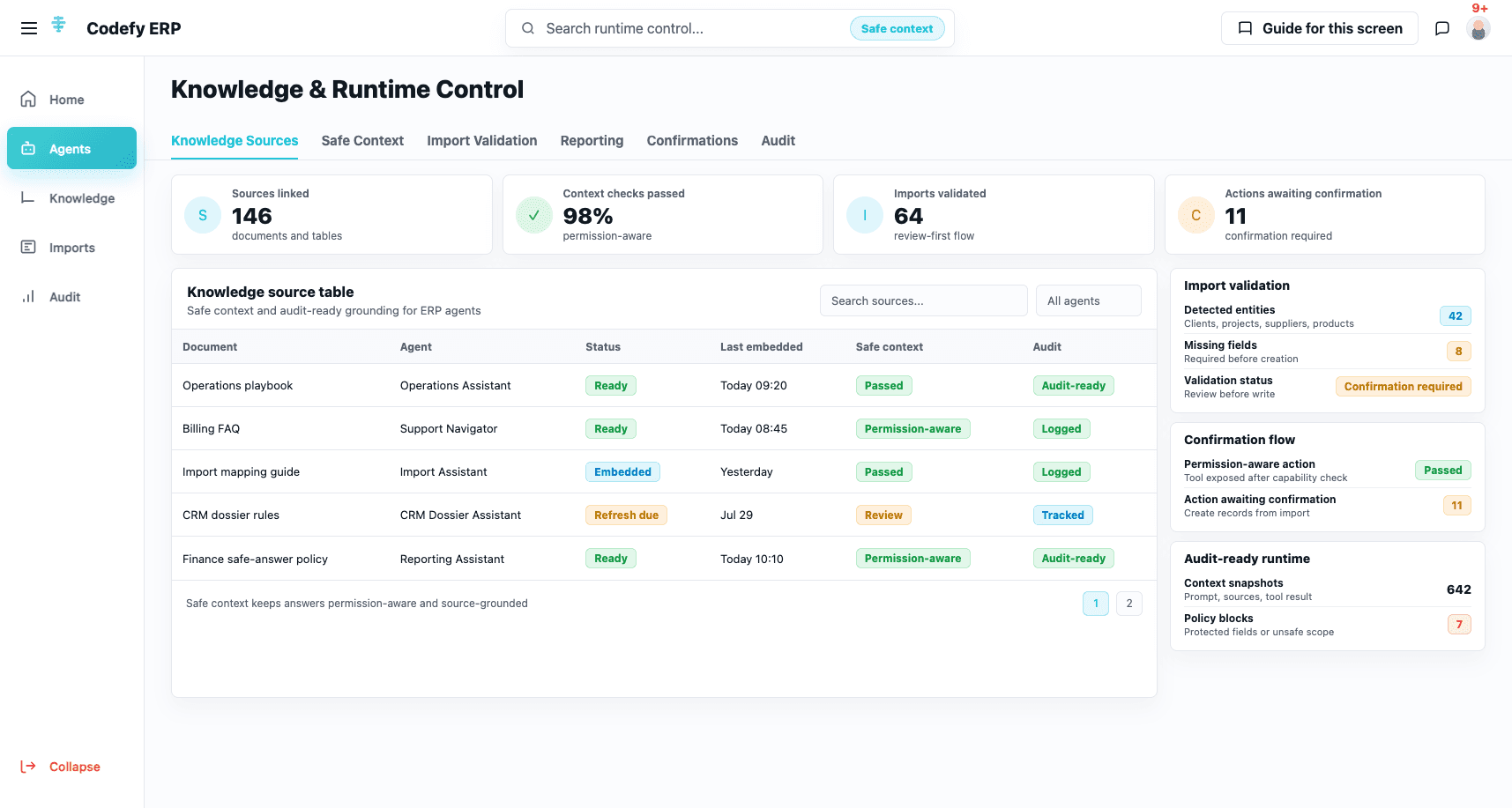
Knowledge and runtime control
Agents can retrieve approved knowledge, use safe ERP context, validate uploads, draft responses, prepare reports, request confirmations, and leave auditable outcomes.
Commercial Value
Codefy ERP keeps agent reasoning, safe context, tool exposure, confirmation gates, tenant scope, billing, and audit controls in the runtime instead of relying on prompt behavior alone.
AI works inside controlled ERP context, with safe catalogs, knowledge grounding, tenant scope, and permission-aware behavior.
Teams can use agents to validate uploads, summarize accounts, draft follow-ups, guide support, and prepare reports without bypassing approvals.
Admins can manage assistants, knowledge sources, widget publishing, usage, model settings, and runtime readiness from one governed AI layer.
Permission-aware answers and confirmation gates keep AI useful while protecting financial, payroll, private, and operational data boundaries.
We can review your agent setup, knowledge sources, import validation, reporting needs, widget publishing, permissions, and confirmation rules, then map the right Codefy ERP AI starting point.